Saturday, January 25, 2014

Winter Vegetable Lasagna

My birthday's coming up this Saturday [today!] and my parents (and little sister) came up to visit and celebrate this past weekend. I thought it might be fun to celebrate by showing off a little: cooking something seasonal and fun. Not mention challenging. So I cast my net out for something I could create with the limited choices available in January. Winter vegetable lasagna answered the call.

I love making lasagna. If I could make only one dish to sum up the kinds of food I love to cook, lasagna would probably be it. I think that's why this dish spoke to me. It added my favorite winter squash, with my favorite starch (interesting enough in my favorite color, which is usual for it), with a new green that I have always wanted to try. All in my favorite sauce and cheese of course.


Lasagna is not an easy dish. Nor is it one for the impatient. Still, this delightful little number was perfect for our winter celebration.

Winter Vegetable Lasagna

[What you need]
1 butternut squash
1 bunch swiss chard
3-5 blue potatoes (amount depends on size of potato. You also don't have to use blue, but they're pretty and very good for you!)
1/2 lb chorizo or Italian sausage
lasagna noodles
tomato sauce
~8 oz ricotta cheese
~8 oz mozzarella cheese
sage to taste

[What to do]

  1. Cube squash and potatoes; Devein the chard and cut into strips.
  2. Precook veggies and meat. I sauteed the chard, boiled the squash and potatoes in the microwave, and browned the meat on the stove. I'm certain your choice method will work just as well here.
  3. Combine the veggies, meat, and a generous helping of sage.
  4. Grease a 9x13 pan (Lasagna sticks. My sister buys disposable pans to make her lasagna it can get that bad.), arrange the noodles and layer tomato sauce, both cheeses, and filling mix.
  5. Repeat until you have reached the top of your pan. Add one final open layer to the top. It looks pretty that way.
  6. Cover and bake at 350*F for 50-60 minutes

[I find that I am slowly turning into my bisnonna as I write this recipes. I have a tendency to want to give you a list of ingredients and say "now go for it!". I'm resisting, of course.]

Monday, January 13, 2014

Beet Greens and Gorgonzola Spaghetti

I would say this dish is part of my Polish-Italian fusion repertoire. Beets, much like cabbage, are an important Eastern European food and goodness are they good for you! For many years, I've been enjoying them on my salads, but as one of my New Year's challenges is to learn how to prepare and use at least 5 new ingredients in my dishes, figured the lovely betaine rich beet would be a great place to start.

There are jars of beets pickling on my canning shelf right now, but that's not the only thing you can do with beets.

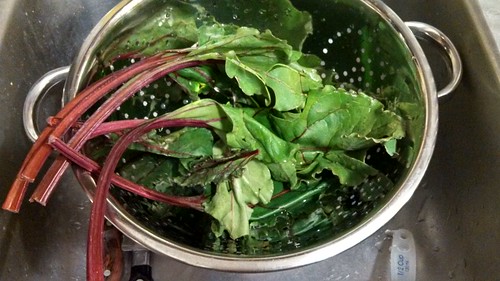
I was intrigued to learn that not only the roots of beets are edible. The tops are too. They're interesting. I was expecting a bitter flavor, like radish tops, but they have a unexpected natural saltiness that really intrigues me.


This recipe is quick and simple; easy enough to whip up on a busy weeknight.

Beet Greens and Gorgonzola Spaghetti

[What you need]
Spaghetti (or pasta of your choice)
Beet Greens chopped from one bunch of beets
Gorgonzola cheese
Tomato sauce
A spoonful of Italian breadcrumbs
Olive Oil

[What to do]
  1. Put on water and start spaghetti
  2. In the meantime, rinse the beet greens and saute them briefly in olive oil
  3. When the spaghetti is ready, stir in the cheese and greens
  4. Top with a small amount of tomato sauce and bread crumbs to serve


Tuesday, January 7, 2014

The Luckiest Dinner of All: Pork, Sauerkraut, and...Black Eyed Peas?

I was considering holding this one until next year so because the whole point of this recipe is to make it for New Year's Day. Still, I figure by the the time New Year's 2015 rolls around, I'll just have to dredge this post up from the archives (and maybe add some better pictures).  Anyway, without further adieu:

"In the nineteenth century, sauerkraut was a cold-weather food. Sauerkraut with fresh pork was a fall dish. Sauerkraut with turkey was a Christmas dish. And sauerkraut with pork was eaten for good luck on New Year's Day, because, as the [Pennsylvania] Dutch say, "the pig roots forward." Thus rooting forward into the new year, the Dutch ate sauerkraut with salt pork in the late winter, and finally, sauerkraut with fish in early spring."
---Sauerkraut Yankees, William Woys Weaver [University of Pennsylvania Press:Philadelphia] 1983 (p. 176)
Eating Sauerkraut on New Year's Eve is a long-standing tradition in Germany. It is believed that eating Sauerkraut will bring blessings and wealth for the new year. Before the meal, those seated at the table wish each other as much goodness and money as the number of shreds of cabbage in the pot of Sauerkraut. -http://www.germanfoodguide.com/holiday-silvester.cfm 

Growing up the traditional meal in my family (and in my region in general) was pork and sauerkraut. Though I do have German (Alsatian, really, but let's not split hairs yet) and Polish background, this little number is from -all- over in my family. From looking around the internet, it somehow has become a "Midwest" thing, which I find interesting. (Hopefully, I won't ever find myself explaining to people that it didn't start in the Midwest like I have to do annually with pączki.)

I've been making pork and sauerkraut every year on New Year's for as long as I can remember. I'm personally a little superstitious about it. One year, I ate a whole plate of sauerkraut at midnight because the year before had been particularly bad. So it goes without saying that this year I was going to make pork and sauerkraut. I could do it in my sleep too: Salt the pork roast and pop it in the slow cooker with a recipe of sauerkraut (I have yet to make my own, but one day I dream to), a cup of brown sugar, and about an inch of chicken broth.

Usually, the side dishes to this meal are corn and mashed potatoes, two foods I hold dear; however, I didn't make them this year. My boyfriend being a southerner (ish), I went out on a limb and explored another New Year's tradition: Black Eyed Peas. I found a wide variety of reasons for these tasty legumes being lucky all over the internet, but I'm not sure if any one reason was definitive yet. I'll leave the floor open for debate.

There are many delicious Black Eyed Pea recipes. I did mine simply since it was my first go: soaked over night, boiled for 45 minutes and then toasted with hot chilies.

All in all, I think I managed to double my luck for 2014 *knock on wood*. 

Happy belated New Year to all of you!

Monday, December 30, 2013

Quick New Years Stir-fry

Been a busy holiday around here. But never fear. I have something super tasty, beautifully colored, healthy and, most importantly, easy for you to whip up during a busy time.


[What you need]
Olive oil
3 cloves garlic
1 head bok choy
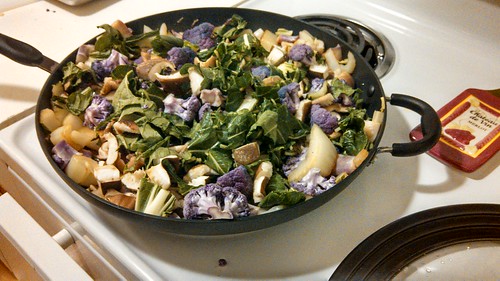
1 head cauliflower (We used purple cauliflower, but any color will do. You have to admit the purple give it a certain something though)
~ 12 oz of shitake mushrooms

[What to do]

  1. Press the garlic and let it sit a few moments as the oil heats up then add it to the pan.
  2. Chop the bok choy, adding the stalks to the pan first (they take longer to cook) then the leaves
  3. Chop and add cauliflower and mushrooms
  4. Cover and simmer for about 5-8 minutes
See? Easy! Perfect for the night when you're tired of cooking elaborate holiday meals

Monday, December 16, 2013

Torrone

Picture, if you will, your favorite childhood candy. Maybe, like my madre, your mind goes to miniature Tootsie Rolls or, like my sister, you're thinking of the ever allusive Zero bar. For me, there are two candies which make my mouth water with nostalgic joy. One is dark chocolate. One is nougat. Both involve almonds. I really don't know if I can stress enough how much I love almonds.


One of these can be found in just about any corner of the world. The other...I have only ever seen in grocery stores that specifically market themselves as "Italian". Because of the lack of such stores in the little nook of the world I find myself in, I've decided to whip up a batch on my own for the holidays.


It turned out to be a lot harder than I thought it would be.


The recipes I found were simple enough. The problem was: it takes a long time and a lot of patience, two things I never really seem to have in spades. If I had to watch a bunch of thermometers and jump back and forth between pots like my other candy making adventures require, I actually might have found this easier. In reality, making Torrone is a highly meditative chemistry lesson ideal for the day I had this Saturday when we snowed in anyway.


Torrone
Adapted from Dellalo and Food52

[What you need]
12 oz of honey (about 1 1/2 cups)
4 cups of whole almonds
3 egg whites
flavoring to taste (a box of Torrone from the store will come with vanilla, lemon, and orange. Lemon is my favorite so I used it exclusively, but feel free to get creative.)
1 1/4 cup powdered suger (optional: for the impatient among us.)
2 sheets ostia wafer paper (which can be found here - honestly, I just used rice paper for my first batch. I mainly include the more traditional detail for the fun story my madre tells in which she and her sisters used to peel the paper off the nougats and "play communion" when they were young.)

[What to do]
1.Set up a double boiler system and pour in the honey. Cook until it is clearly of a liquid consistency, stirring frequently. This took me around an 1 1/2 hours.
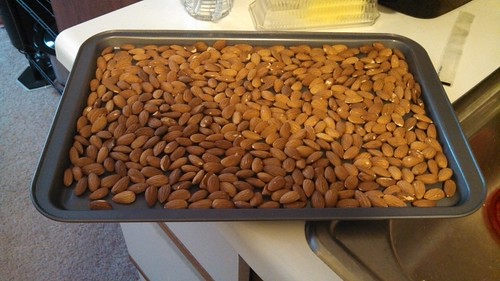
2. In the meantime, roast the almonds. Put them on a rimmed baking sheet in the oven (at around 350 degrees F.)  for 10-15 minutes.
3. Beat the egg whites until stiff peaks form. This step is crucial, do not rush it. The eggs are the binder that bring the whole thing together.
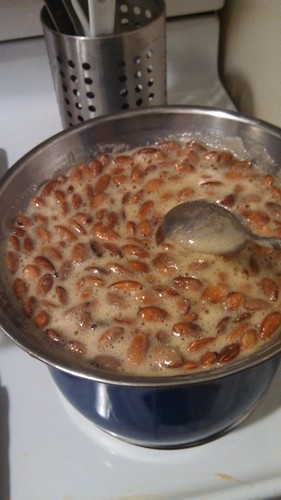
4. Fold the egg whites into the honey. Continue folding until the mixture becomes thick and somewhat caramel-like. This step, also crucial, takes a long time. I, personally, almost gave up on it, thinking that it would never set. Don't panic. Just stir. (If you find that you can't deal with this any longer, add the powdered sugar. It will help thicken things up; however, the candy will no longer be authentic.)
5. Fold in the almonds and flavoring. The mixture should be thick enough that the almonds don't all sink immediately.
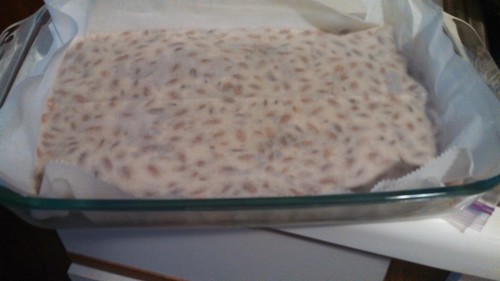
6. Line a baking dish with wafer paper and pour the mixture in. Place another wafer paper on top and press down with your hands or other weight. Set aside for at least an hour while it firms up; it may take longer.
7. To serve, flip it over and cut the nougat into squares.

Wednesday, December 11, 2013

Comfort Food: Slow Cooker Beef Roast

I offer my apologies for the missed post last week and the lateness of this post. You see, I've been doing a lot of cooking lately, but I have forgotten to take pictures. That means we've missed out on some great stuff, but never fear. I will make them a second time, just for all of your benefit. Especially now that I've learned, thanks to Thanksgiving, that people are actually reading this. [I'm still trying to figure out the comments section. I'll let you know when I have that sorted out.]

So without further adieu, a childhood favorite and a good meal for very lazy days: The Slow Cook Beef Roast.

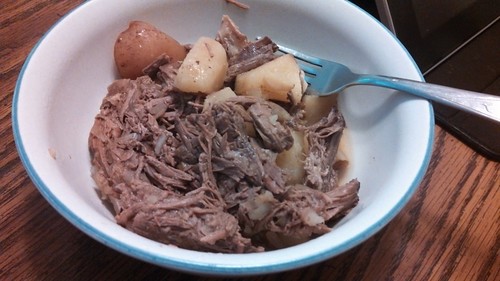
The best thing about this meal is not even the ease of it. It's the smell. Coming home to the smell of this delightful meal simmering away is heavenly. Even more so on freezing winter days like the past few have been.

All it takes is a few vegetables, beef stock, and a beef roast (Just about any cut will do. It will be cooking so long that it will be plenty tender. I assure you.)


Slow Cooker Beef Roast
via (to the best of my knowledge) mi madre

[What you need]
Cut of Beef
Salt
Pepper
Carrots
Potatoes
Onions
Beef Stock or Broth (enough to pretty much cover the roast)
A slow cooker

[What to do]
1. Season the Beef with salt and pepper then add to slow cooker
2. Chop up the various vegetables and add them around the roast.
3. Cover this in stock/broth
4. Cook on low for about 8 hours
5. (and don't forget this step, it's crucial) At some point in that 8 hour period, leave and then come home so you can enjoy that smell.

See? Wasn't that easy?

Monday, November 25, 2013

Polenta

You're about to walk into some contentious territory, so I suggest you prepare yourself.


Polenta is one of those foods that can be found pretty much anywhere (I mean, it's essentially cornmeal mush), but what you put on it drastically varies by region. Fry it and cover it with milk based beef gravy and you've done it Pennsylvania Dutch style. A tomato sauce? Northern Italian territory.

I know, I betraying my Sicilian roots here, but Polenta is tasty and I think it's status as a "peasant food" to the point where I know people ashamed to make it make it a little less of a betrayal.


There are Polenta stories in my family, though most of them involve my mother carefully explaining to me that my bisnonna would probably have never made polenta

All of this aside, I really enjoy the dish. It is a hearty and warm meal that reheats well and is a perfect dish to make large quantities of on cold night as we approach winter.


Polenta
[adapted from Food52]

[what you need]
4 cups ricotta whey (you can get the whey by making this recipe)
1 cup ground cornmeal
1 teaspoon of salt
2 tablespoons oregano
1 tablespoon parsley
1 tablespoon basil
2 tablespoons parmesan cheese

[what to do]
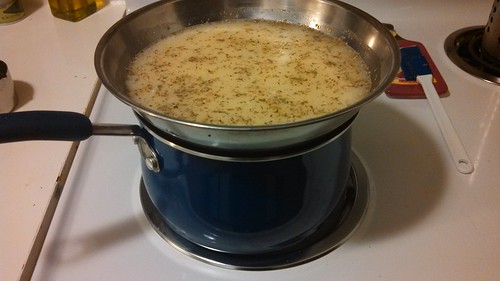
1. Set up a double boiler. (several cups of water in one pan with another pan or bowl overtop)
2. Put whey, cornmeal and seasonings in the top of the double boiler. Stir carefully.
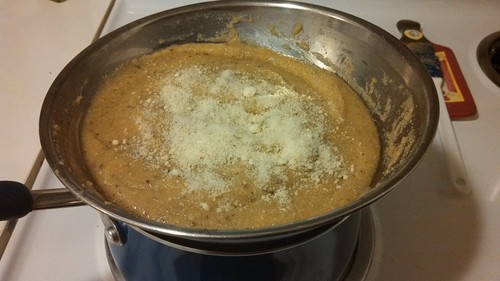
3. Cook until polenta is thick. This should take between 30-45 minutes.
4. Stir in cheese
5. Either top with gravy/tomato sauce and serve or separate into containers for storage and top with choice toppings later. I like to make large batches ahead of time for hearty lunches.